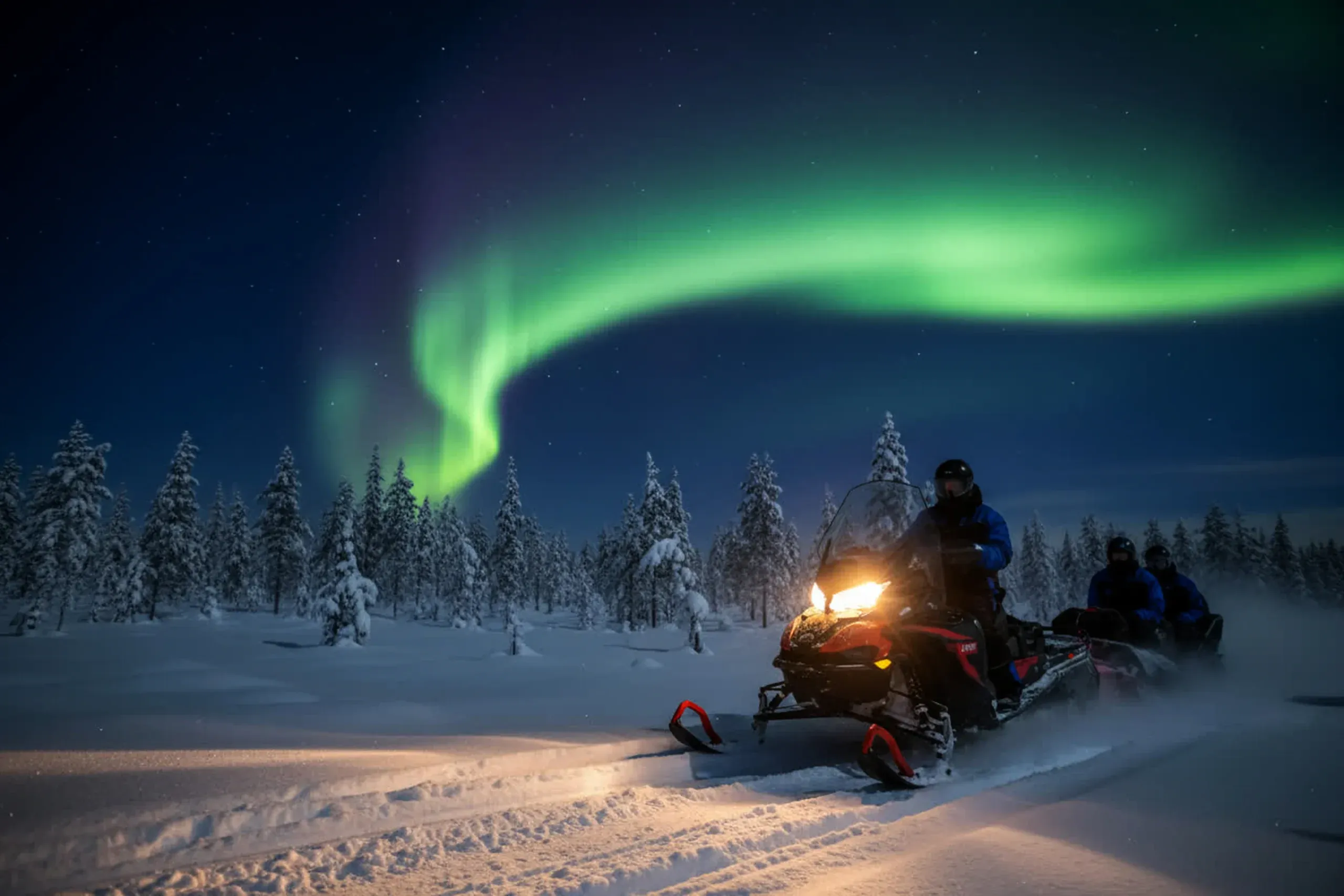
Illustration photo: the aurora over a forest near Rovaniemi, on one of the tours sold through this site. A display like this is a Lapland sight rather than a Helsinki one.
Yes, but rarely. The Finnish Meteorological Institute puts the Helsinki region at one night a month that is statistically possible for seeing the aurora, against three nights in four at Kilpisjärvi in the far north-west and every second night around Sodankylä in Lapland. One night a month is a real number rather than never, and people in southern Finland do photograph the lights — but it is not something you can plan a trip around, and that is precisely why the aurora trade sits far further north.
The short answer people want is yes or no, and the real one is a number. The
Finnish Meteorological Institute publishes it: in the very southernmost part of
the country, around Helsinki, only one night a month is statistically possible
for seeing the aurora.
That is not never. It is also not something to build a holiday on.
What one night a month looks like next to the rest of Finland
The same page gives figures for four other places, and they are the argument in
full.
Where
How often auroras are seen
Kilpisjärvi, far north-west
Three nights in four, in clear skies during the dark season
Utsjoki, northern Lapland
About ten percentage points lower
Sodankylä, Lapland
Every second night
Oulu–Kuusamo
Every fourth night
Helsinki region
One night a month is statistically possible
The two ends of that table are not measured quite the same way — the northern
figures are nights with a clear sky in the dark season, the Helsinki one is
nights that are statistically possible at all — so dividing one by the other
gives an order of magnitude rather than a clean multiple. That order of
magnitude is roughly twenty. Those are not odds you can improve by trying
harder, staying up later or picking a better spot. They are where you are
standing.
Rovaniemi itself is not on the institute’s list. It sits between Sodankylä and
the Oulu–Kuusamo area, and rather than split the difference and print a number
nobody published, we will say only that: somewhere between every second night
and every fourth.
Why the tours are all in the north
This is the whole reason the aurora industry has the geography it has. An
operator in Helsinki would be selling a one-in-thirty chance; an operator in
Rovaniemi is selling something that happens often enough to organise an evening
around, and the job becomes finding a hole in the cloud rather than waiting for
the aurora to reach that far south.
What that evening is actually worth, and when you are better off standing in a
field by yourself, is the subject of the
northern lights guide.
A Helsinki sighting is a different kind of event
The nights when the lights do reach the south are the exceptional ones, and
they are not announced a week ahead. The people who catch them are the ones who
were already watching for them.
That changes what you can plan. In Lapland, booking a tour for Tuesday is
reasonable. In Helsinki the only workable plan is to know what to do on the
night it happens, which is to get out of the city lights quickly and look north.
What to do with the answer
If the aurora is the point of the trip, go north. That is the entire conclusion,
and everything above it is the arithmetic behind it. Rovaniemi is the practical
version — a city with an airport, hotels, and operators whose evening job is
finding clear sky.
If Helsinki is where you already are and you cannot travel, the answer is not to
give up. It is to accept that you are waiting for an event rather than booking
one, to keep an eye on the forecasts, and to know in advance where you would
drive to when the night comes.
Questions people ask
If we are staying in Helsinki anyway, where should we stand?
Somewhere open, dark and facing north. The Finnish Meteorological Institute's advice for southern Finland is that the aurora usually appears in the northern sky, so the best spot is one with an unobstructed view of at least the northern horizon, and that you should get away from the light pollution of built-up areas to an open, dark place. It also warns that proper night vision takes tens of minutes to develop, so a five-minute look out of a hotel window from a lit street is not a serious attempt.
What time of night should we be out?
Around midnight, though not only then. The institute puts the peak of the relevant geomagnetic disturbance at about 23.30, which is magnetic midnight, and says the aurora is most typically seen either side of midnight while appearing at any point through the night. In practice that means a Helsinki attempt is a late one: you are standing outside in the dark at eleven at night, in winter, for something that might not arrive. Plan for the following morning accordingly.
Is one month better than another?
Only slightly, according to the institute, which says auroras occur fairly evenly through the year with somewhat more in autumn and spring. What changes across the year in Helsinki is not the aurora but the sky: you need darkness and you need it cloudless, and the capital's summer nights never get properly dark. That leaves the dark half of the year, and inside it the limiting factor is whatever the weather is doing on the night you happen to be there.
Written by
Lapland Handbook Staff
Lapland Handbook is written by its editorial staff in Rovaniemi. Every price, age limit and group size in a comparison is read from the operator's own page and marked "Not stated" when the operator does not publish it. Each guide names who should not book, and says so when a competitor is the better choice.
Ready to book something?
Every tour we list is one you can book direct, with the operator's own
published price. Use the code LH10 at checkout and 10%
comes off it.